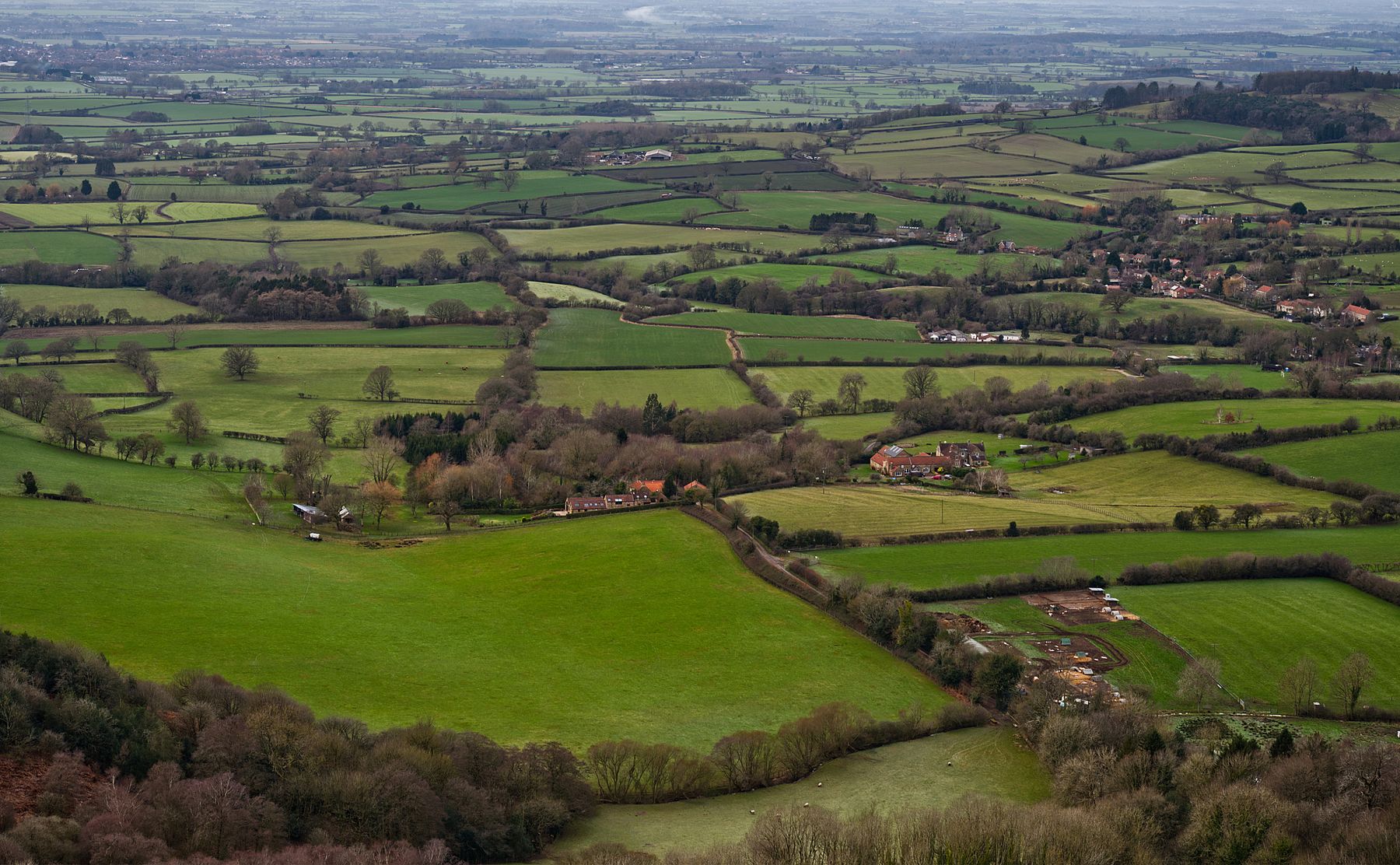
England has had a nitrate law since 1991 and has designated 55 per cent of its land a Nitrate Vulnerable Zone since 2002. Agriculture still accounts for around 60 per cent of the nitrogen reaching rivers in England and Wales. This is why regulation at the point of application has not closed the gap, and what would.
Nitrate is the most heavily regulated pollutant in English farming, and it is still the one we cannot get out of the water.
Almost every nitrate rule in England governs the moment of application. How much you may apply, when you may apply it, how close to a watercourse, on what slope, into what soil condition. These are sensible rules and they are worth keeping.
But nitrate does not leave a field at the moment of application. It leaves months later, dissolved in water, moving down through the profile or across the surface. What decides whether it leaves is not the rule. It is whether the soil could hold on to it in the meantime.
Nitrate is highly soluble and carries a negative charge, so unlike phosphate or potassium it is barely held by soil minerals at all. What holds it is living soil: organic matter, root mass and the microbial biomass that takes mineral nitrogen up and locks it into organic forms until a crop needs it. A global meta-analysis of organic inputs found exactly this effect, with carbon rich amendments promoting the conversion of mineral nitrogen into organic forms and reducing leaching and run-off losses.4
England’s arable soils have already lost between 40 and 60 per cent of their organic carbon.5 We have spent thirty-five years regulating what goes on to soil that has progressively lost its ability to keep hold of it.
Catchment Sensitive Farming has been the government’s flagship response since 2006. Natural England’s own evaluation of phases one to four, covering 2006 to 2018, recorded nitrogen down 4 per cent in the catchments where it operated.6
Meanwhile the Environment Agency inspected 15,006 farms between April 2021 and March 2026 and found 48 per cent non-compliant, a rate that has barely moved in five years: 52, 49, 50, 49 and then 43 per cent.1
Every kilo of nitrogen that leaves a field has to be removed again downstream, in a plant that has to be built, powered and paid for every year the load keeps arriving.
None of that cost appears on a farm invoice, and none of it is recoverable. It is paid by bill payers for as long as the load keeps arriving.
Tap water in England is treated to standard and is safe to drink. The problem is not that treatment fails. It is that treatment is the most expensive possible place to solve a problem that begins in a field, and it has to be paid for again every single year.
If nitrate leaves because the soil cannot hold it, then the durable fix is to restore the soil’s ability to hold it. That means organic matter, root depth and biological activity, built back over years rather than applied in a season.
It also means the change has to pay for itself on the farm, because thirty-five years of evidence says voluntary advice moves the needle by single digits and enforcement produced 36 prosecutions in five years.1 A soil that holds its own nitrogen needs less bought in, and that is the only version of this that a farm business will sustain without being paid to do it.
The Soil First Initiative works on the soil itself, using natural soil biology to build structure and organic matter so farmland holds rain and nutrients instead of shedding them. It is done field by field and catchment by catchment, the land stays in full production throughout, and the change is measured in the soil and in the water. See how it works, or read the full evidence file.
A law in 1991. An advice service in 2006. Statutory farming rules in 2018. In 2026, fourteen per cent.
Named by the Environment Agency itself. Fifty-five per cent of river water bodies fail the standard.
The Environment Agency’s own words, and a 2030 target with nothing measuring it.